Your Dish Soap Is Designed To Attack Grease — What Is It Doing To Your Skin?
The ingredients behind the bubbles, “power clean,” and lemon-fresh smell.
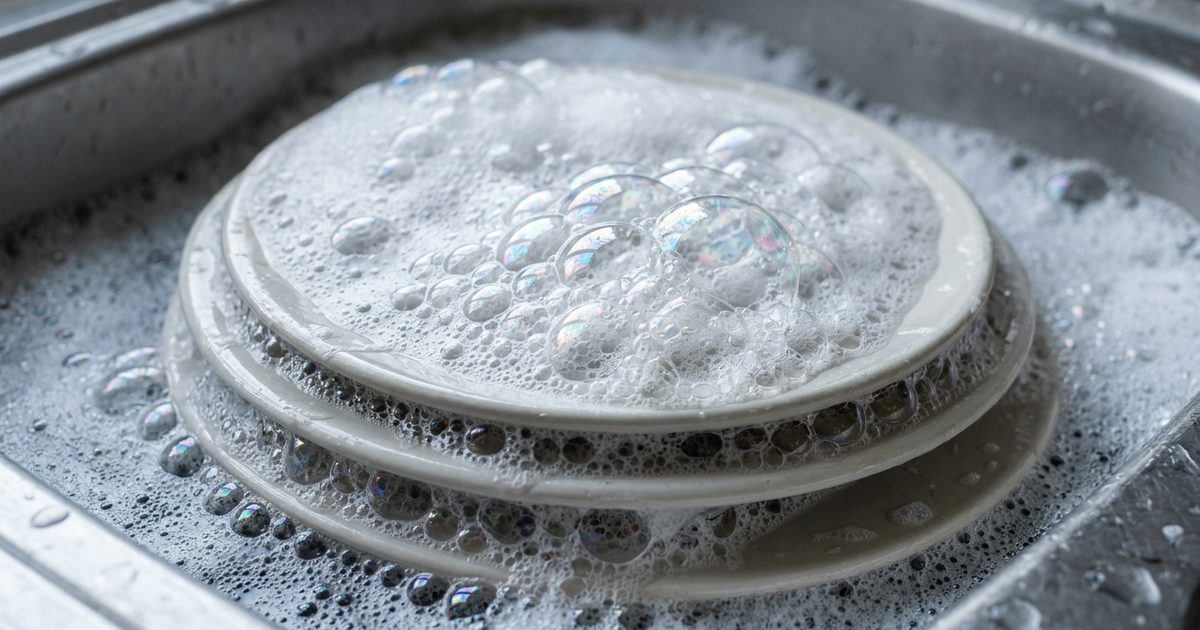
Dish soap has one job: destroy grease.
To do that, manufacturers build formulas around powerful surfactants that break apart oils, suspend food residue, and make everything rinse away with water.
That chemistry is effective.
But there is another side to the equation.
The same product you use on your plates may touch your hands dozens of times a week. And unlike the occasional exposure people imagine when they hear “household chemical,” dishwashing is a repeated exposure pattern.
The biggest question is therefore not whether dish soap contains chemicals.
It does.
The better question is:
Which ingredients actually need to be there — and which ones are mainly there to make the product sell?
The Dish Soap Formula Nobody Thinks About
A typical liquid dish soap can contain several different classes of ingredients:
- Surfactants to remove grease
- Preservatives to prevent microbial growth
- Fragrance chemicals for scent
- Dyes for appearance
- pH adjusters
- Thickeners
- Solvents
- Chelating agents
- Stabilizers
Some are essential to making a water-based detergent work safely.
Others mainly improve texture, color, smell, or shelf appeal.
That distinction is important.
A longer ingredient list does not automatically mean a dangerous product. But if two products clean equally well, there is little reason to choose the one with additional ingredients that you do not need.
The Best Signal: understand what each ingredient actually does.
Ingredient No. 1: The Grease Destroyer
Sodium Lauryl Sulfate
Sodium lauryl sulfate, or SLS, is one of the classic surfactants used to make cleaning products effective.
Its chemistry is almost perfectly suited to dishwashing.
One end of the molecule interacts with water.
The other interacts with oils and grease.
Together, surfactants help break large greasy deposits into smaller particles that can be suspended in water and washed away.
That is why detergent works so much better than plain water.
But there is a catch.
SLS is also well known in dermatology as a skin irritant. Researchers frequently use it in controlled studies specifically because it can produce measurable irritation and increase skin-barrier disruption under sufficient exposure.
That does not mean washing one plate with SLS-containing soap is dangerous.
The important variable is dose and exposure.
A person washing dishes for five minutes with diluted detergent is experiencing something very different from someone repeatedly soaking their hands in concentrated detergent throughout the day.
What To Watch For
If your hands regularly become:
- Dry
- Tight
- Red
- Itchy
- Cracked
- Burning
after dishwashing, the detergent may be contributing to the problem.
The Default Assumption should not be “this soap is toxic.”
It should be:
Repeated detergent exposure may be stressing the skin barrier.
Ingredient No. 2: The One That Prevents Your Soap From Growing Mold
Preservatives
Here's an uncomfortable contradiction.
You might think a product with fewer preservatives is automatically better.
Not necessarily.
Dish soap contains a lot of water.
Water + nutrients + time can create an excellent environment for microorganisms.
Preservatives help prevent that.
Without an effective preservation system, the product itself could become contaminated.
So preservatives serve a legitimate purpose.
The problem is that some preservatives are also known sensitizers.
Methylisothiazolinone: A Small Ingredient With A Big Reputation
Methylisothiazolinone, commonly called MI or MIT, is an antimicrobial preservative.
It has become particularly controversial because it can cause allergic contact dermatitis in sensitized individuals.
Unlike ordinary irritation, allergic contact dermatitis involves an immune response.
Someone can develop:
- Redness
- Severe itching
- Dryness
- Scaling
- Cracking
- Blistering
The FDA recognizes methylisothiazolinone and related preservatives among cosmetic ingredients capable of causing allergic reactions.
And here's the important distinction:
Not everyone exposed to MI will become allergic.
The concern is that repeated exposure can matter for people who are susceptible.
If you already have unexplained recurring hand irritation, checking the preservative system may be more useful than simply searching for “natural” on the front label.
Your Lemon Scent Isn't Cleaning Anything
Fragrance
This might be the easiest category to question.
Your dish soap smells like:
🍋 Lemon
🌊 Ocean
🌿 Fresh
🌸 Lavender
But none of those smells remove grease.
The fragrance exists primarily for the consumer experience.
And fragrance can represent a mixture of multiple chemicals rather than one simple ingredient.
For most people, this isn't automatically a major health concern.
But if you are trying to minimize unnecessary exposure — particularly if fragrances irritate your skin — fragrance-free is an easy place to start.
You lose the lemon smell.
You don't lose the ability to wash a plate.
The Blue Color Doesn't Make Your Plates Cleaner
Dyes
Look at dish soap and you will often see bright colors designed to communicate what the product is supposed to feel like.
Blue suggests freshness.
Green suggests natural or herbal.
Yellow suggests lemon.
But the dye itself generally contributes nothing meaningful to grease removal.
This creates one of the simplest rules in household-product shopping:
If an ingredient does not improve cleaning and you can easily avoid it, why add it?
That is not an argument that every dye is toxic.
It is an argument for reducing unnecessary formulation complexity.
The Ingredient With A More Complicated Chemistry
MEA, DEA And TEA
Ethanolamines such as monoethanolamine (MEA), diethanolamine (DEA), and triethanolamine (TEA) can be used for useful formulation purposes.
They may help with:
- pH control
- Emulsification
- Stability
- Mixing oil and water
The controversy comes from chemistry involving nitrosamines.
Certain nitrosamines are potent carcinogens, and regulators pay attention to the possibility of nitrosamine formation in formulations containing certain amines.
But here's where many internet articles go too far.
Finding an ethanolamine on an ingredient list Does Not Guarantee that a carcinogenic nitrosamine has formed.
Formation depends on the complete formulation and the presence of appropriate nitrosating conditions.
So “contains TEA = carcinogenic” is not a scientifically sound conclusion.
The more defensible takeaway is:
Formulation chemistry matters more than isolated ingredient panic.
The “Power Clean” Trap
Here's something worth noticing the next time you're standing in the supermarket.
You may see:
Original
Ultra
Power
Ultimate
Platinum
Maximum
Deep Clean
These names sound like completely different technologies.
Often, they're not.
Manufacturers can modify:
- Surfactant ratios
- Fragrance systems
- Enzyme systems
- Preservatives
- Thickeners
- Solvents
- Packaging
without fundamentally changing how the product removes grease.
That doesn't mean premium products are scams.
It means marketing names are not technical specifications.
The ingredient list tells you far more.
More Bubbles ≠ Cleaner Plates
This is one of the biggest misconceptions in dishwashing.
People see a mountain of foam and assume:
More foam = more cleaning.
Not necessarily.
Foam is primarily a sensory signal.
Actual cleaning depends on:
- Surfactant chemistry
- Concentration
- Temperature
- Contact time
- Mechanical scrubbing
- Water hardness
- Type of food residue
A low-foam detergent can clean extremely well.
A huge pile of bubbles can simply mean you're getting more bubbles.
Don't buy foam. Buy cleaning performance.
The Hidden Variable: Your Hands
This is where the story becomes more interesting.
Dish soap is not primarily designed to interact with human skin.
It's designed to interact with grease.
Your skin also contains lipids.
That's why detergents can remove some of the oils that help maintain the skin barrier.
Add:
- Hot water
- Frequent washing
- Long exposure
- Scrubbing
- Existing dry skin
and you have a very different exposure scenario from simply touching a bottle once.
This is why occupational “wet work” is a recognized risk factor for hand dermatitis.
The issue isn't necessarily one scary chemical.
It can be the repetition.
The 10-Second Dish Soap Test
You don't need a chemistry degree to make a better choice.
Turn the bottle around.
Then ask five questions.
1. Is it heavily fragranced?
If yes, ask whether you actually need the fragrance.
2. Does it contain unnecessary dyes?
If yes, consider whether the color provides any useful function.
3. Is the ingredient list transparent?
More information is generally better than vague proprietary descriptions.
4. Does your skin react to it?
Your own repeated exposure history is useful information.
5. Are you using far more than necessary?
More detergent does not automatically mean cleaner dishes.
What About “Natural” Dish Soap?
Be careful with this label.
Natural does not automatically mean:
Non-irritating.
Plant-derived fragrance compounds can still cause allergic reactions.
Natural preservatives can still have biological activity.
And a “natural” detergent can still contain powerful surfactants.
The Default Assumption that natural = safer is just as unreliable as the assumption that synthetic = dangerous.
Look at the formulation.
Not the marketing story.
The Simplest Formula May Be The Smarter Formula
If two dish soaps perform similarly, there is a reasonable argument for choosing the one with:
- Fewer unnecessary fragrances
- No unnecessary dyes
- Transparent ingredients
- A well-designed preservative system
- Effective but not excessive surfactant levels
- Clear manufacturer safety information
This doesn't mean every ingredient should be eliminated.
Some ingredients exist because the product needs them.
Preservatives are a good example.
A preservative-free liquid detergent that becomes contaminated is not necessarily the healthier option.
The goal isn't:
“No chemicals.”
The goal is:
“Only the chemistry that serves a useful purpose.”
What Actually Matters Most
Forget the front of the bottle.
Forget the bubbles.
Forget “ultimate clean.”
For everyday dish soap, the hierarchy is much simpler:
Exposure
How frequently are you using it?
Skin contact
Are your hands repeatedly exposed?
Irritation
Does the formula leave your skin dry or damaged?
Sensitization
Does it contain ingredients known to cause allergic contact dermatitis?
Formulation complexity
How many ingredients are present that provide little practical benefit?
Transparency
Does the manufacturer tell you what you're actually buying?
That's a much better framework than simply labeling ingredients “good” or “bad.”
How To Use Dish Soap More Intelligently
You don't need to stop using dish soap.
You can simply reduce unnecessary exposure.
Try to:
- Use the minimum effective amount.
- Avoid prolonged soaking of your hands in detergent.
- Wear gloves if frequent dishwashing irritates your skin.
- Rinse dishes thoroughly.
- Choose fragrance-free products if fragrance bothers your skin.
- Consider dye-free formulations.
- Don't assume more foam means better cleaning.
- Don't use concentrated detergent as a hand soap.
- Follow the manufacturer's directions rather than creating your own dilution.
And if a particular detergent consistently causes irritation, switch it.
That's one of the simplest exposure reductions available.
The Bottom Line
Dish soap isn't secretly poisoning your kitchen.
But it is also not just “soap.”
It is a carefully engineered chemical system designed to attack oils, suspend food residue, prevent microbial growth, and remain stable on a shelf.
Some of those ingredients can irritate skin.
Some can cause allergic sensitization.
Others are there for legitimate technical reasons and shouldn't be treated as inherently dangerous.
The strongest evidence is not that ordinary dish soap causes systemic disease.
It's that repeated exposure to detergents can matter for the skin, particularly in people who are susceptible to irritation or contact dermatitis.
So the smartest buyer isn't looking for a mythical “chemical-free” dish soap.
They're looking for something much simpler:
Effective cleaning. Fewer unnecessary extras. Transparent ingredients. And less exposure than you actually need.
Sources
- DermNet — Soaps and Cleansers
- FDA — Allergens in Cosmetics
- Human and Environmental Toxicity of Sodium Lauryl Sulfate — PMC
- International Journal of Molecular Sciences — Irritant Contact Dermatitis and Sodium Lauryl Sulfate
- Environmental Science and Pollution Research — Environmental Risks and Toxicity of Surfactants
- Campaign for Safe Cosmetics — Ethanolamine Compounds